Plan Sets
Engineered
from Code.
Permit-ready sets in minutes instead of days — every value derived from your AHJ, utility and financier's rules, not guessed.
Designs itself. You keep the override.
Circuits, interconnection method, conductor sizing — computed against hundreds of rules you control. Overrule any of it and everything downstream recomputes around the change.
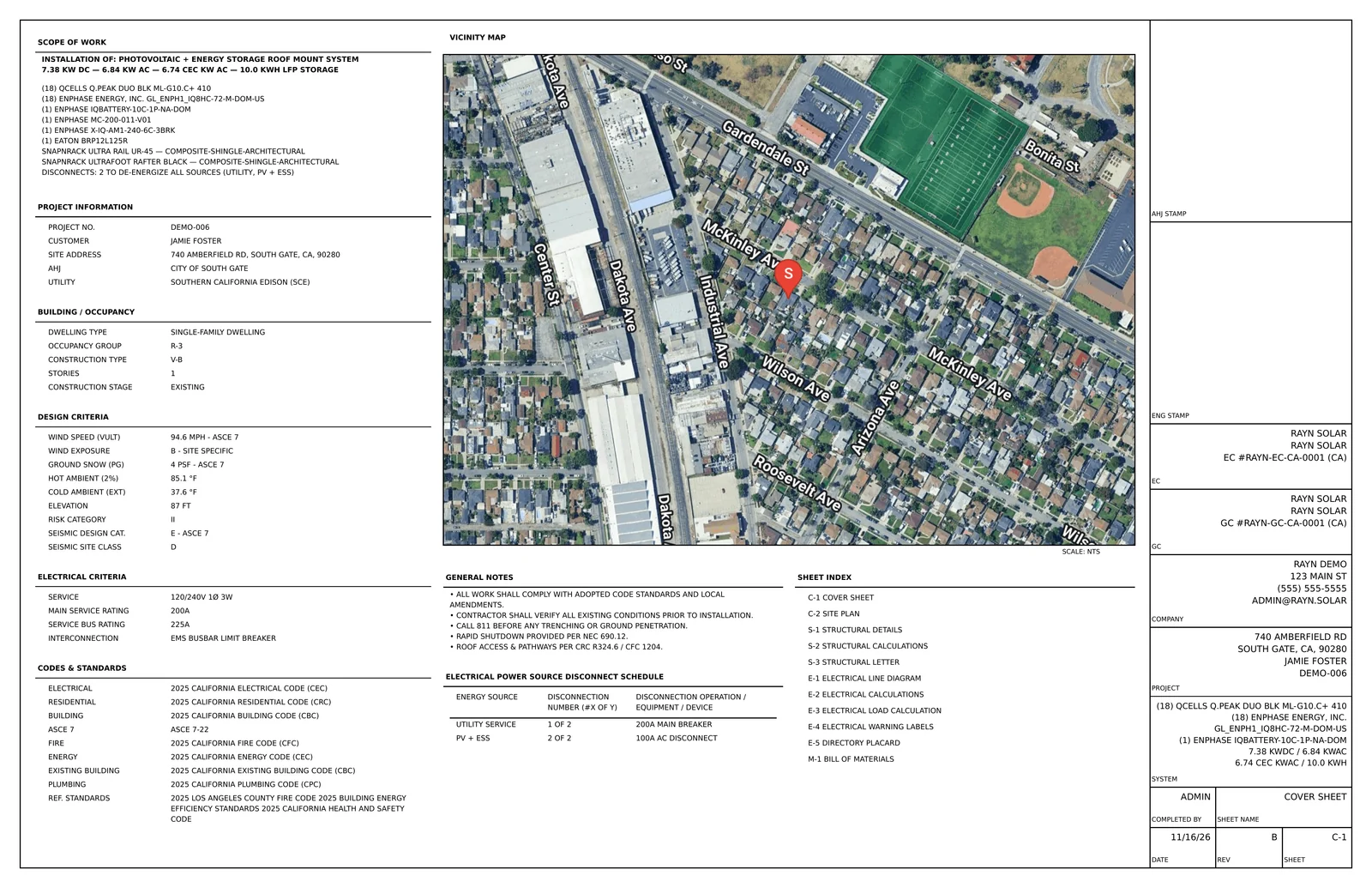
Cover sheet.
Project data, design criteria, code list, sheet index, auto-generated vicinity map. Stamps sit where the plan checker expects to find them, because that's the first thing they look for.
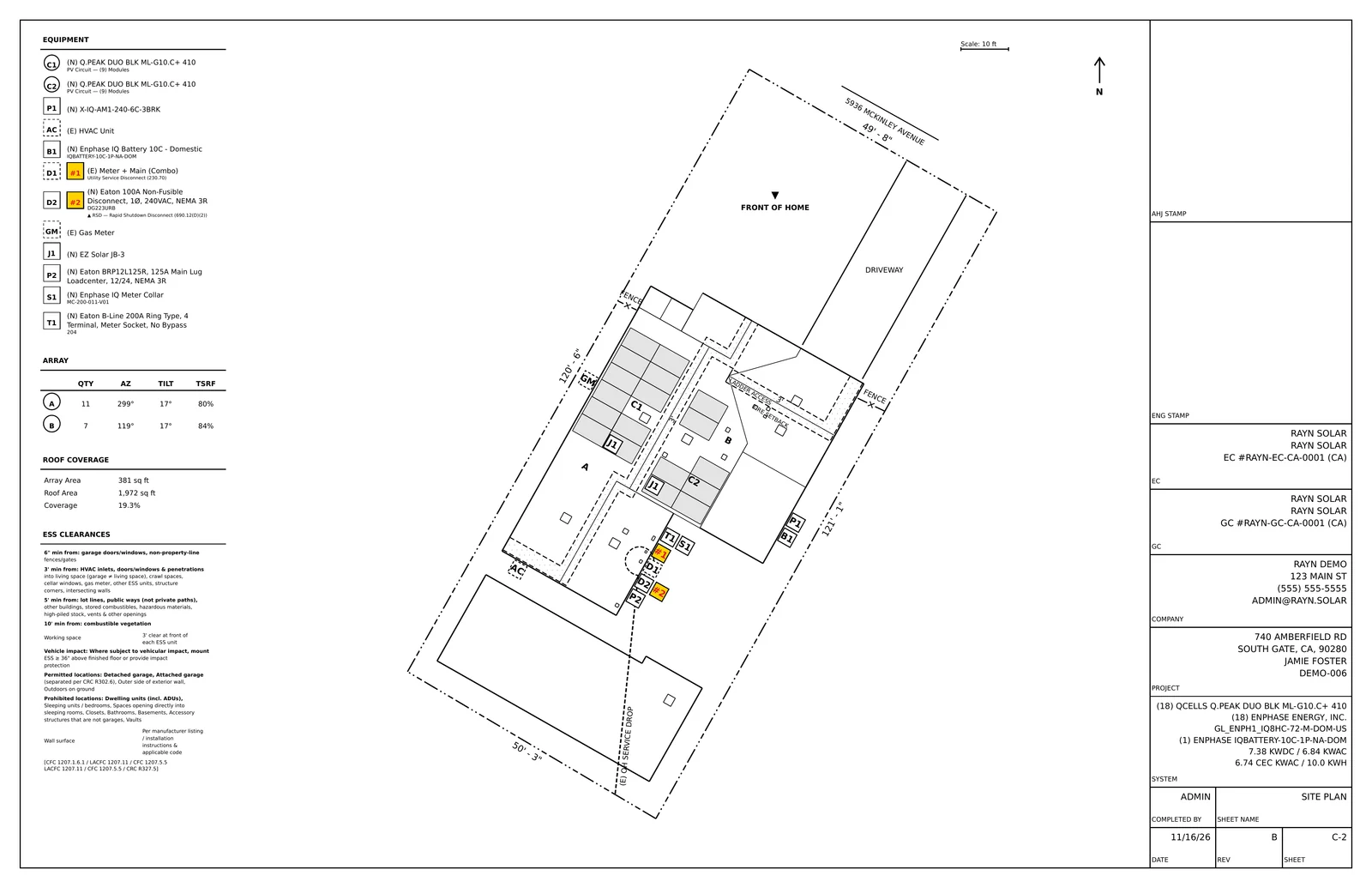
Site plan.
Property line, fire setbacks, array sections with azimuth and TSRF, roof coverage, equipment locations, and ESS clearances with the code cited on the sheet. The numbered disconnects are an LA County requirement — Rayn drew them because a rule in that market says to, not because someone remembered on the day.
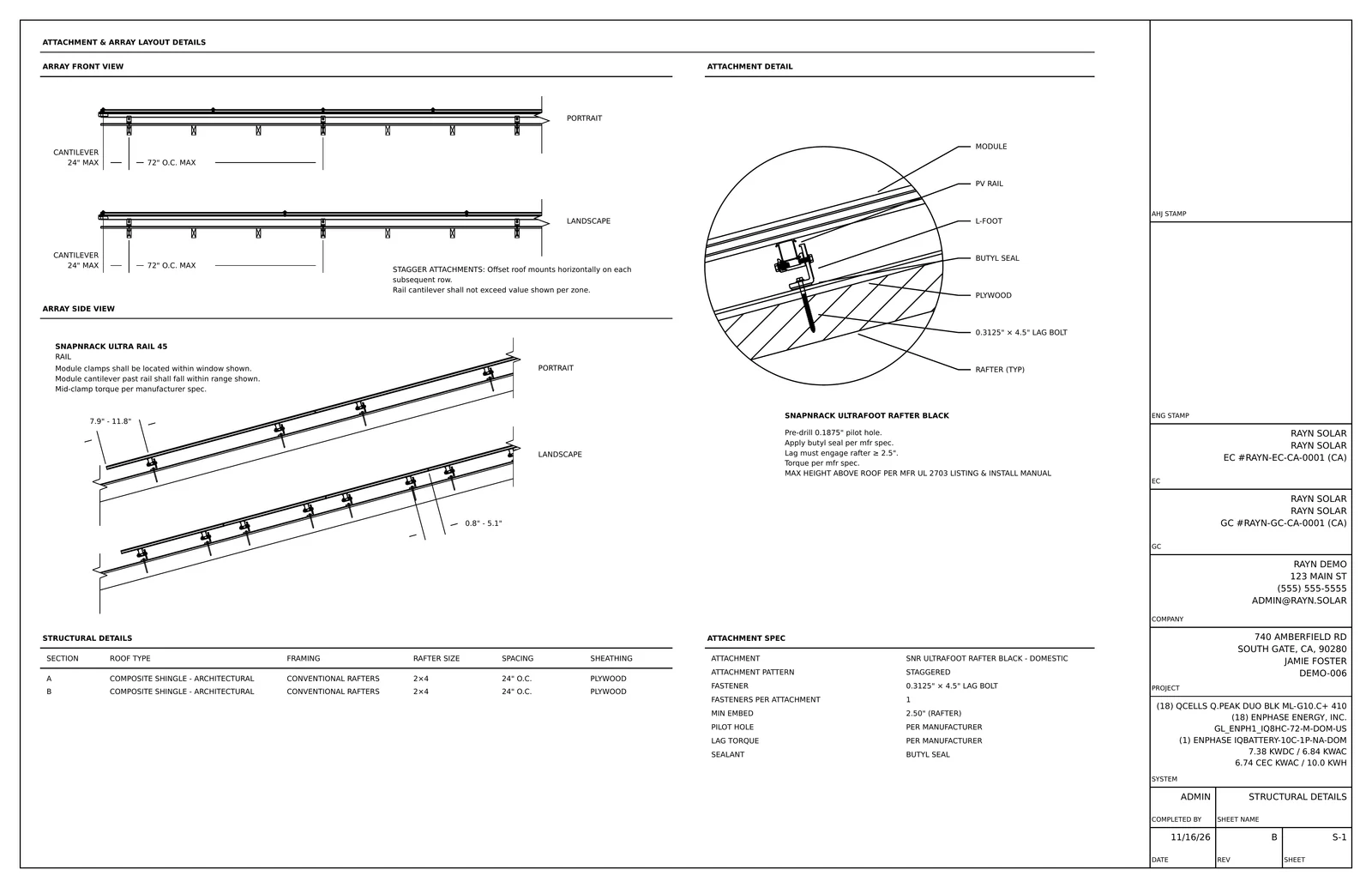
Structural details.
The attachment detail is drawn for the fastener that's actually in the bill of materials — lag diameter and length, minimum rafter embed, butyl seal, pilot hole. Array elevations carry the cantilever and span limits of the rail you specified, not a generic one. Framing is listed per roof section, because the two faces of a roof are rarely the same.
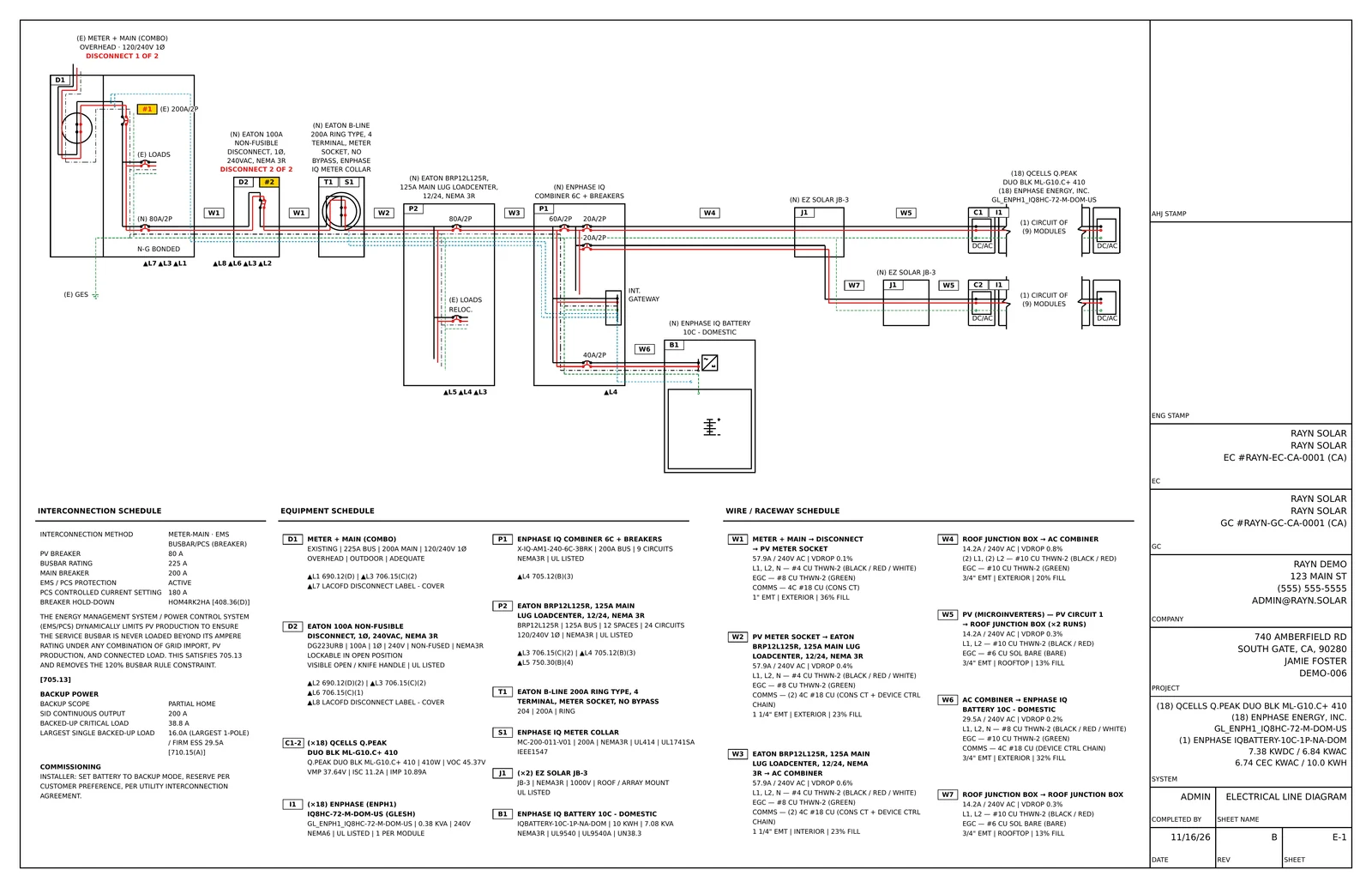
Electrical line diagram.
Wire and raceway schedule with voltage drop and conduit fill on every run. Equipment schedule with real MPNs. Interconnection schedule with the busbar math shown. Look closer — this is the part that gets redlined, and it's the part Rayn is built around.
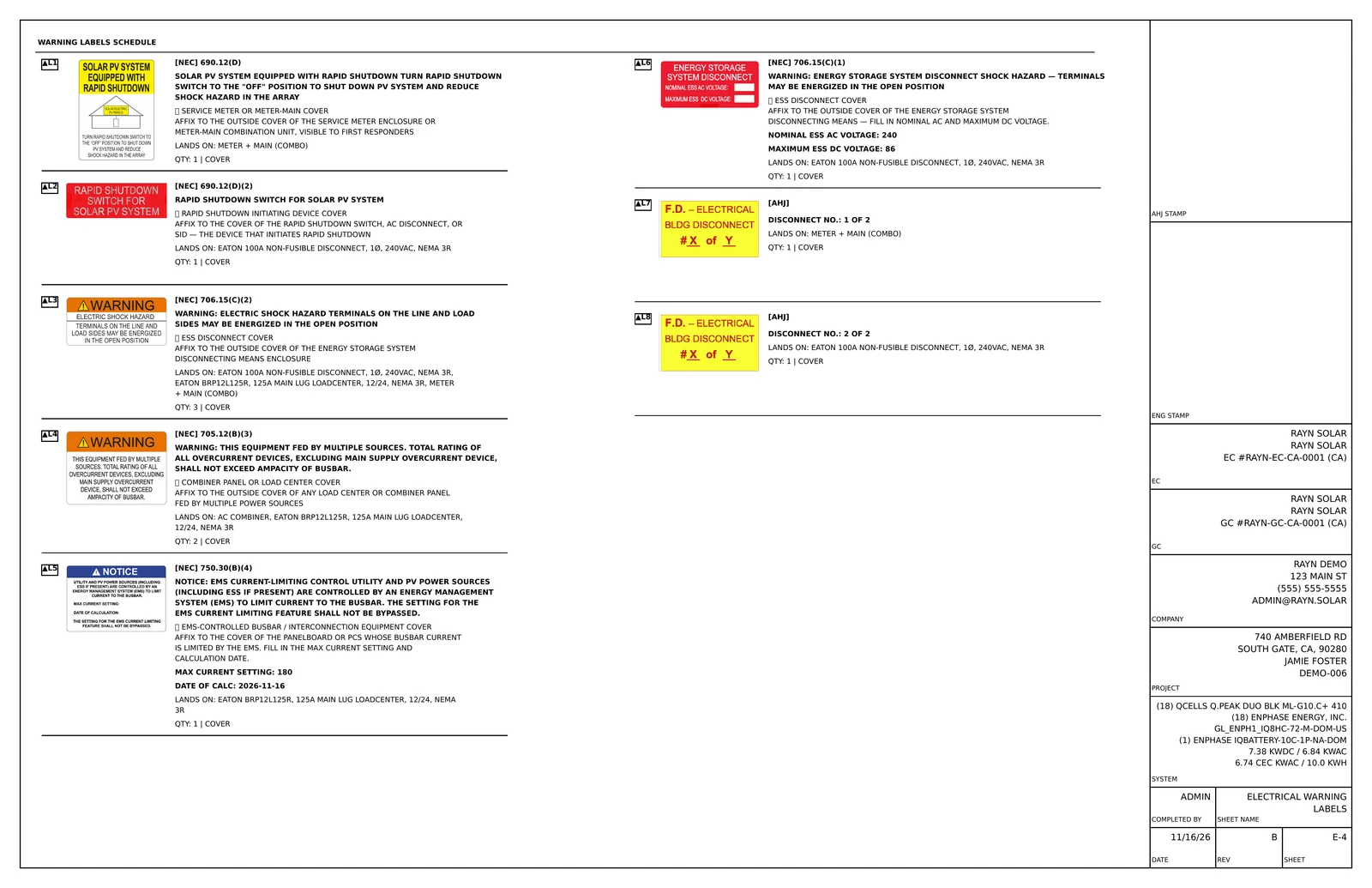
Warning labels.
Every placard carries the code section that requires it and the specific enclosure it gets affixed to — 690.12(D) on the meter-main, 706.15(C)(2) on three separate covers, 705.12(B)(3) on the combiner. Quantities come from counting the covers, not from a guess. The fire-department disconnect placards are there because a rule in that jurisdiction asks for them.
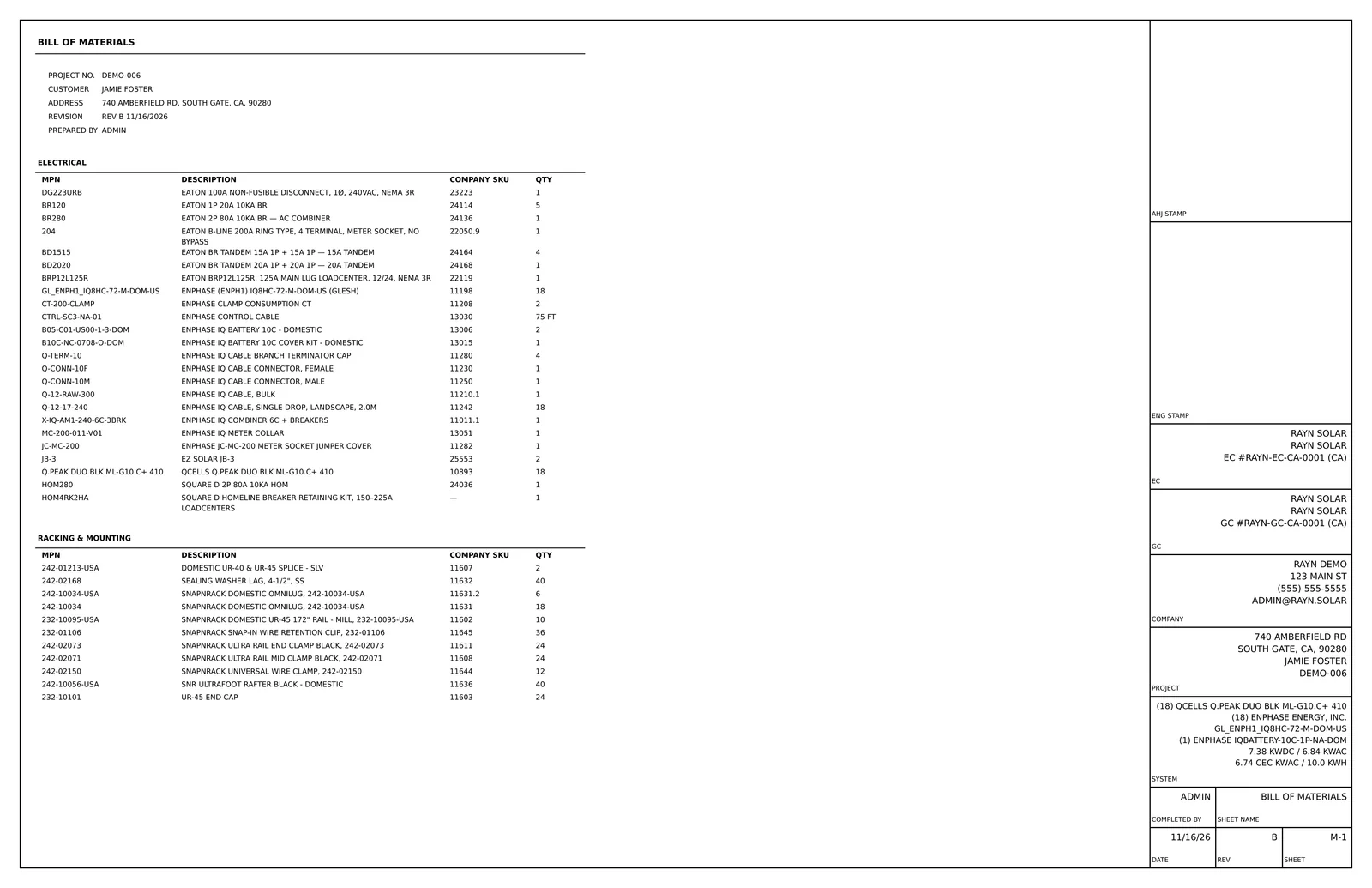
Bill of materials.
Resolved against your company catalog down to the SKU — lag counts, rail lengths, control-cable footage. Anything Rayn can't resolve is flagged for review instead of quietly shipping wrong. An honest gap beats a confident error.
Runs on your rules.
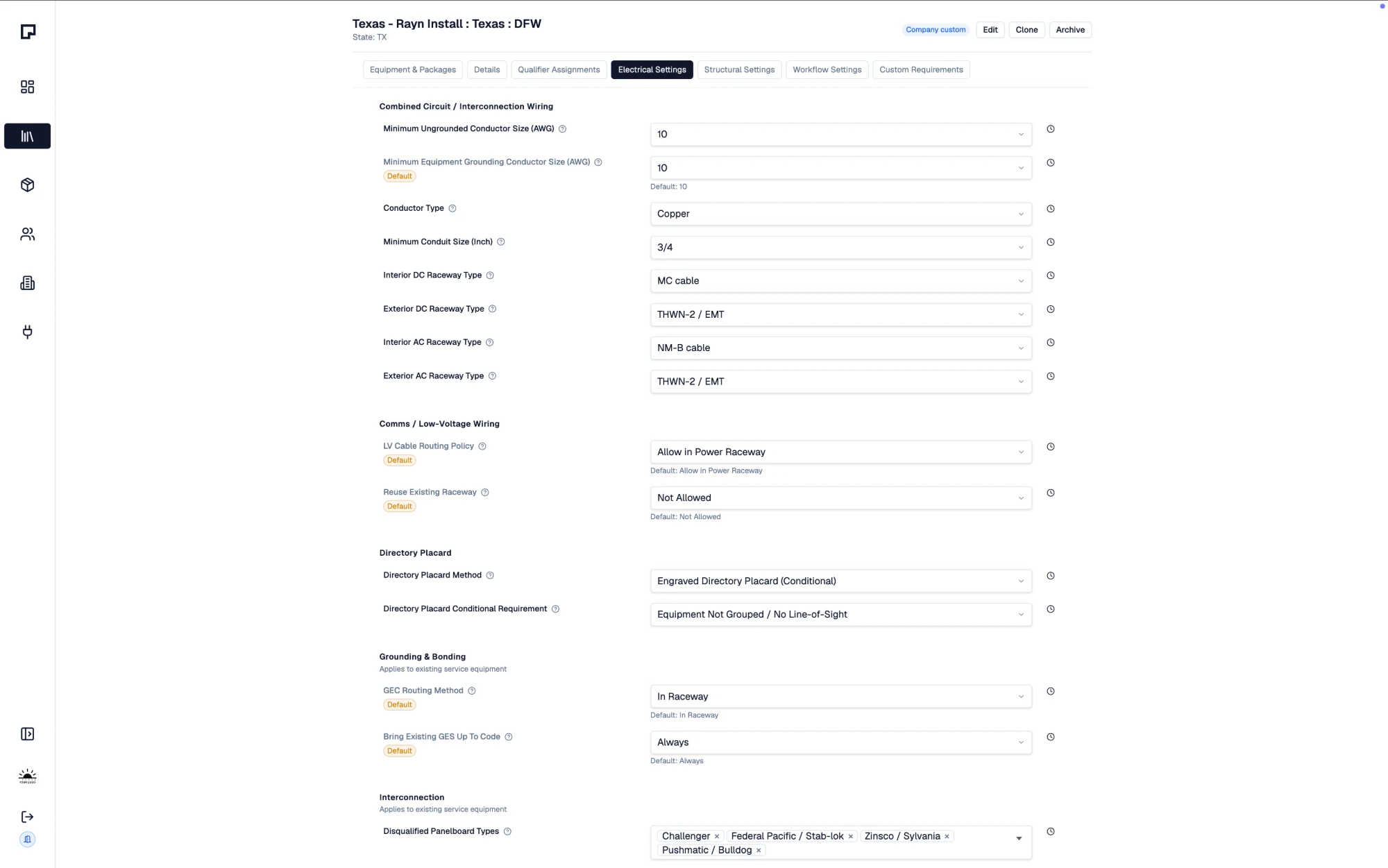
Four sets of rules land on every job, and they don’t always agree. The AHJ has its ordinance and local amendments. The utility has its interconnection handbook. The financial partner has an approved equipment list. Your own market has the way your crews actually build.
Rayn resolves all four on every job and tells you which one won. Set the thing your jurisdiction does differently once, and every job in that market inherits it — with the ordinance, handbook page or plan-check redline carried along as its basis.
Verified requirements join the shared library. Your preferences never leave your account.
Won't let you submit it wrong.
Speed only counts if the set comes back approved. And none of this depends on hiring better designers — it's the same team you have now, working against rules that don't forget.
The export is a gate
Rules run against the design continuously, and the ones that matter stop the set from generating — a missing load calc, an unplaced disconnect, a spec sheet nobody uploaded. You find out at your desk in the morning, not from the plan checker three weeks later.
Every value has a basis
The ordinance section, the handbook page, the redline from the last plan check in that city. When a reviewer questions a number, you cite it instead of redrawing it.
Fixed once, per market
Resolve a plan-check comment once and every future job in that jurisdiction is built against it. The second submittal in a market is cleaner than the first, and the hundredth is cleaner still.
Address to permit-ready package. 25 minutes when the APIs can't fill the site data, against a 90–120 minute baseline.
Engineered sheets in every package, before the ones a jurisdiction conditionally adds. Generated and versioned together.
Equipment models in the core catalog — modules, inverters, breakers, storage, racking. Or build your own.
Permit-issuing AHJs carrying codified requirements. Every other US jurisdiction inherits your tuned defaults.
Rule definitions across jurisdiction, utility, market and financier — each tunable, saved as a profile.
Behind every sheet.
Electrical, structural, labeling and materials come out of one derivation, so the sheets can't disagree with each other. Tune a rule and all of them move together.
Rail spans, attachment spacing, ASCE 7 wind and snow pressures for the exact site, dead load check — plus a stamped letter when the jurisdiction asks for one.
Hundreds of AHJ and utility settings, tuned per project and saved per market — fire setbacks, rooftop EGC floors, DC raceway rules, interconnection variants. Set the one thing your city does differently once; every job in that jurisdiction inherits it.
Rules run continuously against the graph and tell you exactly what's blocking completion — missing load calc, unplaced equipment, untraced property line.
Powerwall 3 and IQ Battery, partial and whole-home backup, System Isolation Device topology, EMS/PCS busbar protection under 705.13.
Permit ready. Instantly.
Address in the morning, stamped PDF in the afternoon. Submit it, install it, get paid — and when the plan checker comes back with a comment, revise the inputs and regenerate the set. For the rare job that has to go to CAD, the whole set exports as DXF. You are never holding a drawing you can't take somewhere else.
Built for volume.
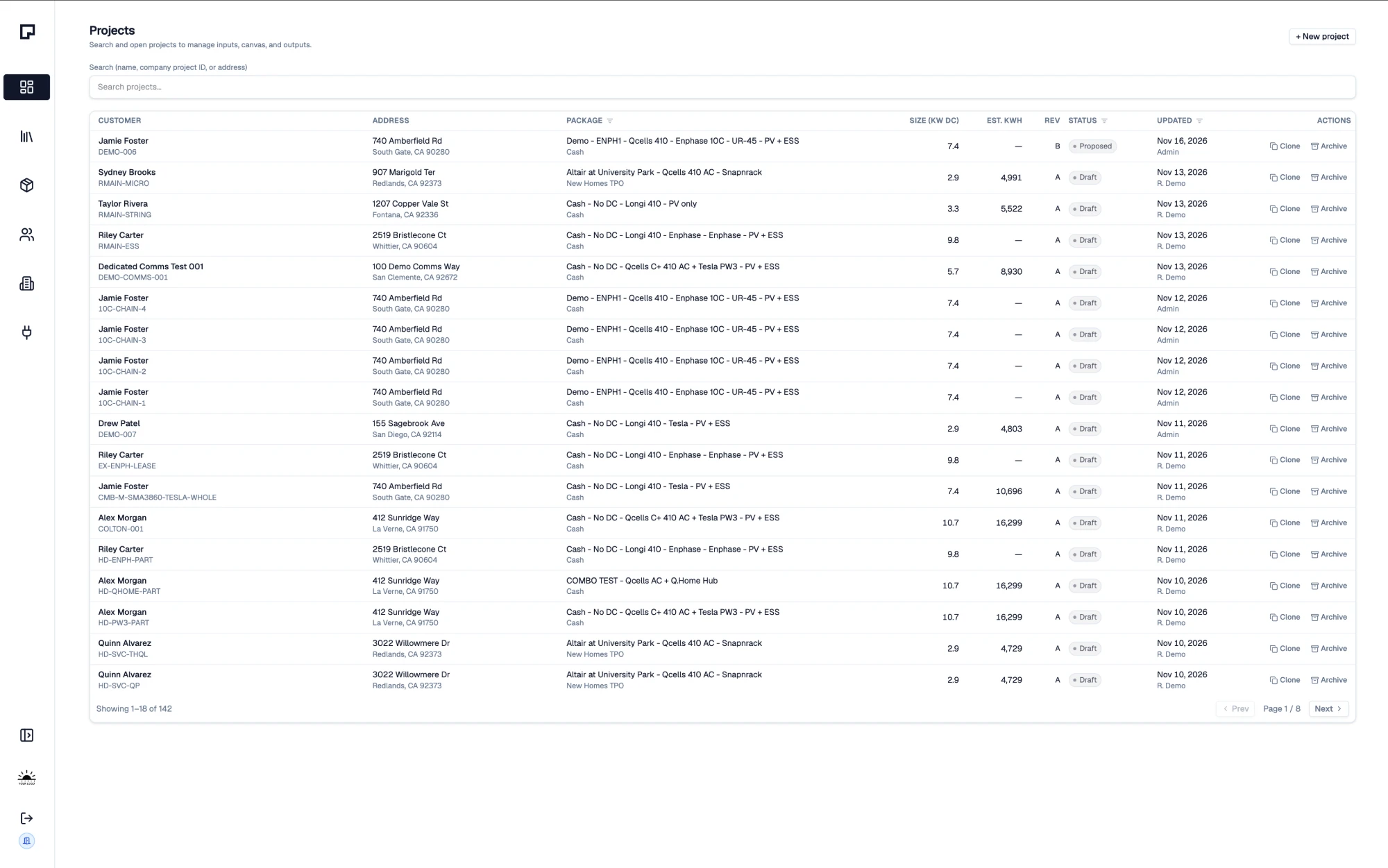
Whether you're running a design floor or pulling your own permits, the setup is installer-scoped: your equipment, your markets, your packages.
More output, same headcount
Your designers are turning two to four sets a day. The bottleneck isn't their skill — it's redrawing the same topology, then chasing the revisions that follow. Rayn removes both, with the designers you already have.
Stop waiting on a vendor
Bring design in-house without building a design department. The package is ready the same day the survey lands, and revisions take minutes.
Sets that don't look self-drawn
Solo operators get the same sheet set the volume shops get — same code coverage, same title block, same plan checker reaction.
Bring a job. Watch it get built.
Tell us your market and the equipment you install. We'll load it before the call. Then, in about 20 minutes, we build a permit set for one of your addresses — in your AHJ and utility, with every code check showing as it runs.
Rayn is written by a licensed electrical contractor and NABCEP PV Installation Professional — not a drafting shop working from a code book. Every rule in it came off a job that had to pass.